Okoume Panels for Boat Interiors and Yacht Cabinetry
Okoume is chosen below deck for two reasons that appear in the same drawing: a pale red face that takes a clear finish evenly, and a lower density than most hardwood plywoods, which is weight saved above the waterline. Published compliance options for the line include CE EN13986 documentation with E1 and E0 low-emission glue systems.
Key takeaways
- Okoume carries a relatively low density, which is why it is specified where handling weight and stability both matter.
- The published face is a pale red to pinkish natural veneer with a uniform grain structure.
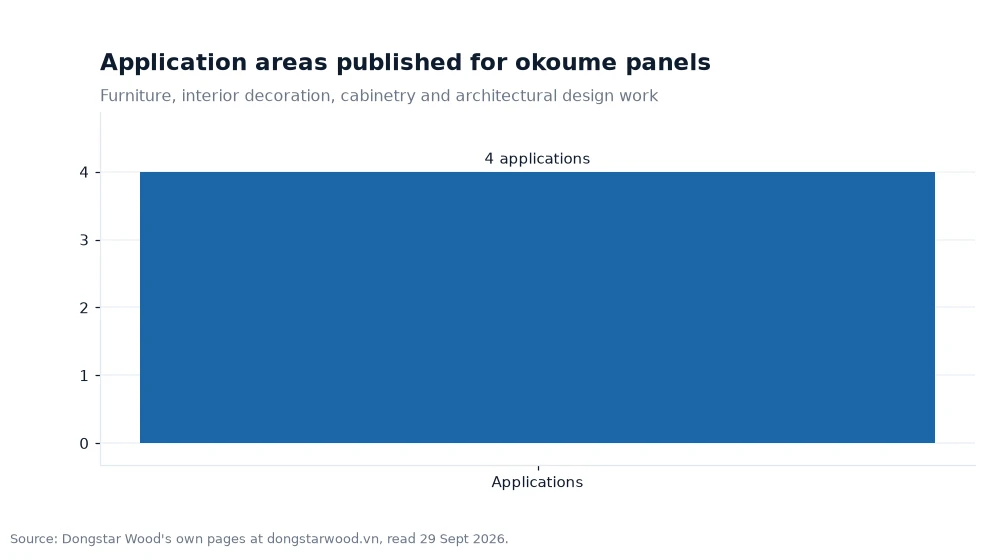
- Four application areas are listed: marine, furniture, interior decoration, cabinetry and architectural design work.
- Compliance wording names CE EN13986 along with E1 and E0 low-emission glue classes.
Why low density earns its place above the waterline
The published description says it plainly: okoume is relatively low in density next to many hardwood plywoods, which keeps the panel easy to handle and helps it hold its shape. On a boat that translates into cabinetry and interior elements installed without adding weight where the designer did not plan for it.
Low density is also a workshop advantage. A 1250 × 2500 mm hoist and two people can position a sheet on a bench or behind a bulkhead without the panel fighting them, which keeps edge quality intact during fitting and reduces the number of pieces that have to be re-cut.
The pale red face under a clear finish
Okoume's natural face is described as pale red to pinkish in tone with a uniform grain structure, and that combination is the reason it turns up so often in interior joinery. Under a clear sealer the grain shows through evenly, and under a stain the tone can be pushed warmer or deeper without the figure breaking up.
The page also notes that the surface accepts paints, stains, laminates and clear sealers. That flexibility matters on a refit, where a client asks for a lacquered finish in the saloon and a laminate-faced surface in a service area while the same substrate is being ordered for both.
Application areas published for the panel
Five uses are named on the product page, and they overlap in a way that suits a yard buying one substrate for several trades. The list below follows the published grouping rather than a builder's own sequence.
| Published application | Typical elements | Why okoume suits it |
|---|---|---|
| Furniture | Chairs, tables, cabinets, wardrobes | Even grain and stable panels for repeated assembly |
| Interior decoration | Wall cladding, ceiling panels, partitions | Uniform face that takes paint or clear sealer |
| Cabinetry | Boat and yacht cabinets, storage units | Controlled density for handling in tight spaces |
| Architectural designs | Doors, trims, decorative accents | Calibrated veneers for tight joints |
| Marine interiors | Yacht cabinetry, boat interiors, lightweight elements | Low density with reliable dimensional stability |
Calibrated veneers and tight thickness tolerance
The page credits calibrated veneers and precision pressing for the panel's tight thickness tolerance and smooth surface. In a marine interior that is not a cosmetic claim: a cabinet door that sits proud of its frame by half a millimetre will read as a gap once it is varnished and the light catches it.
Calibration also helps the finishing stage. A face that is flat and consistent takes a lacquer or a laminate without the sanding and filling that a wavy panel demands, and the installer spends time fitting rather than correcting the substrate.
Worked example: cutting a cabinetry package
A galley refit with sixty cabinetry panels at an average finished size of 0.6 m² each needs 60 × 0.6 = 36 m² of panel (example). Allowing a nesting factor of 1.15 for cut-outs and rails gives 36 × 1.15 = 41.4 m² to order (example).
The larger 1250 × 2500 mm format works out at 3.125 m² a panel (1.25 m × 2.5 m), so the package is 41.4 ÷ 3.125 = 13.2, rounded up to 14 sheets (example). Running the same calculation in a 1220 × 2440 mm format gives 2.98 m² a sheet (1.22 m × 2.44 m) and 41.4 ÷ 2.98 = 13.9, rounded to 14 sheets (example) — the point at which the two formats stop being interchangeable.
CE EN13986, E0 and E1 in a marine interior
The published compliance line reads CE EN13986 for the panel, with low-emission glue systems in E1 and E0 classes. On a vessel the emission question is about air quality in a sealed cabin, and the material question is about how the glue behaves where humidity is constant rather than occasional.
Ask for the documentation to travel with the order rather than being described in correspondence. A buyer specifying CE EN13986 can compare a certificate scope against the panel being shipped, which is a faster check than asking a supplier to restate a claim in writing after the container has left.
Confirming supply before the first container
Sourcing is where okoume differs from a plantation hardwood. The product page states that the veneer comes from sustainably harvested okoume timber native to Africa, and buyers with a due diligence file will want that chain described in the same terms as the certificates.
An Okoume Plywood Supplier being asked to quote for marine interiors should be able to confirm three things in one reply: the sizes in stock or on schedule, the glue system on the panel, and the compliance documentation that applies to the batch. A reply that answers all three is a better signal than a page of reassurance.
Ask for packing that protects a face, not only a panel. A pale red veneer marks easily, so interleaving, wrapping and edge protection matter as much on a cabinetry order as the panel build itself.
Confirm the format twice. A galley front and a bulkhead panel may come from the same substrate, but a yard ordering only 1220 × 2440 mm can find itself nesting three pieces where one 1250 × 3000 mm sheet would have covered the job.
Then fix the finish system before the substrate. Clear sealer, stain, paint and laminate each place different demands on the face, and a supplier who knows which one applies can advise on grade rather than simply quoting a size. It is a short question with a long effect on how the finished interior reads.
Frequently asked questions
Is okoume suitable for structural marine work?
The published application list covers yacht cabinetry, boat interiors and lightweight structural elements, alongside furniture and interior panelling. Where a drawing calls for a primary structural member, that specification is normally settled separately; the panel's published strength for that role is the compliance line, not a marketing description.
How does the face take paint, stain and laminate?
The pale red to pinkish face has a uniform grain structure and is described as accepting paints, stains, laminates and clear sealers. A clear sealer keeps the natural tone visible, a stain shifts it warmer or deeper, and a laminate or veneer cover leaves the face to serve as a clean substrate.
Where does the timber come from?
The page states that the veneer is sourced from sustainably harvested okoume timber, a species native to Africa. Buyers running a due diligence process should request the documentation that applies to their consignment rather than relying on the description alone.
Choosing the neighbouring panel
Two comparisons are worth making before a marine enquiry is closed. Buyers who need a lighter, brighter face for interior joinery can read the birch panel specification and set it beside okoume under the same finish, while anyone assembling a package that mixes cabinetry with formwork or commercial panels can start from the wider panel range.
Application lists and compliance wording follow the maker's own website, viewed on 29 September 2026 and used in these notes and used in these notes and used throughout this article[1].