OEM or ODM? A First-Time Founder's Checklist Before You Sign Anything
OEM means you bring the formula and the factory builds to it. ODM means the factory brings a developed concept and you adapt it. The decision is not about which is cheaper today; it is about which party owns the technical risk, and that answer should be written down before a single sample is made. A first-time founder who settles that question early avoids most of the expensive surprises later.
Key takeaways
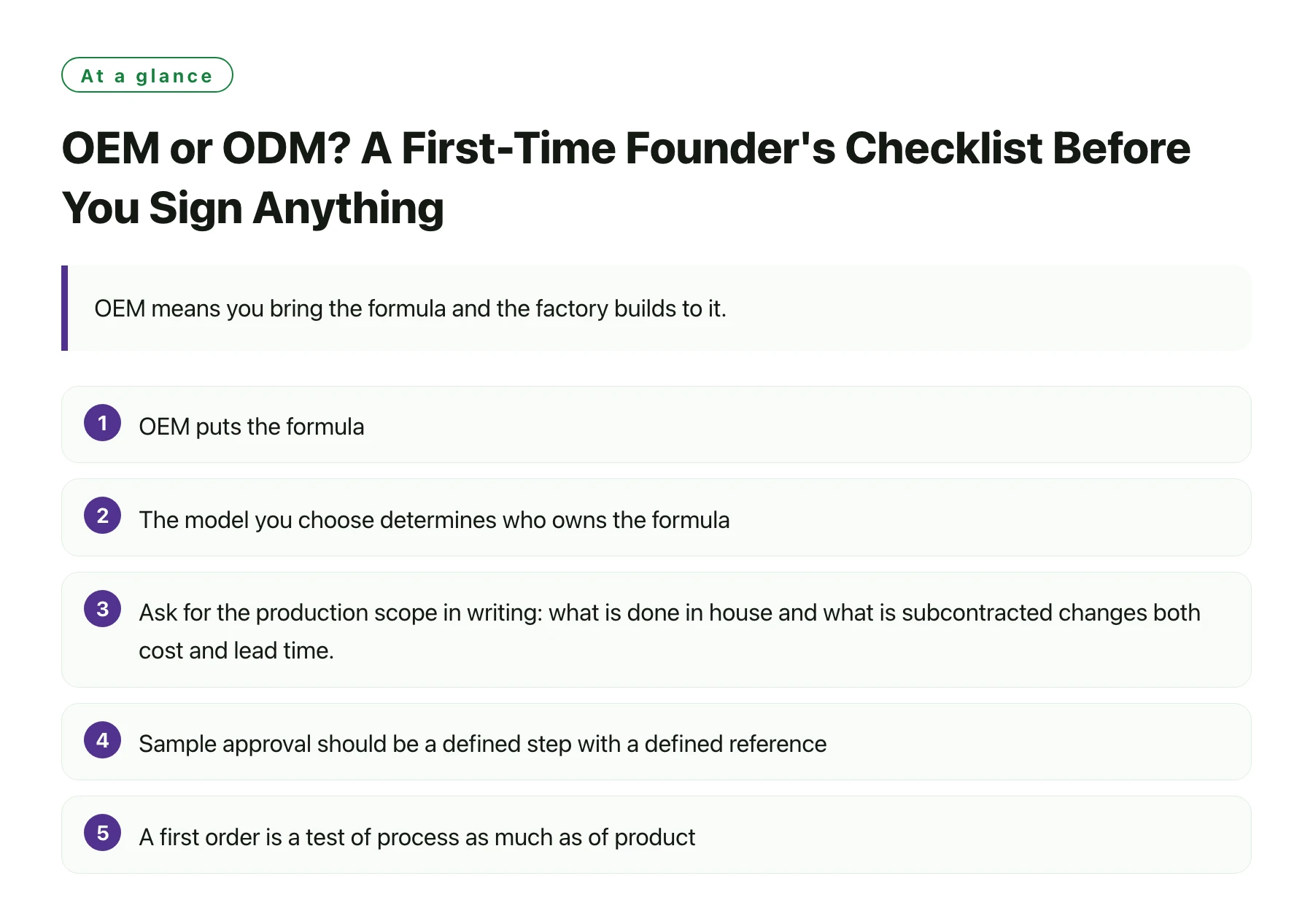
- OEM puts the formula, the specification and the technical risk on the brand; ODM shifts development to the manufacturer and lowers the cost of starting.
- The model you choose determines who owns the formula, the mould and the design files when the relationship ends.
- Ask for the production scope in writing: what is done in house and what is subcontracted changes both cost and lead time.
- Sample approval should be a defined step with a defined reference, not an informal nod over a photograph.
- A first order is a test of process as much as of product; a supplier who cannot show batch records cannot be audited.
Most founders start this conversation by asking for a price. That is the least useful first question, because price depends on decisions that have not been made yet — who develops the formula, who owns the mould, how the product is filled and what documentation the destination market requires.
The OEM and ODM distinction is a good place to start instead. It sorts the project into two very different shapes, each with its own commitments, and once a founder understands which shape their business actually needs, the rest of the conversation gets shorter.
What follows is the checklist worth working through before a contract, a deposit or a tooling order.
What each model actually commits you to
In an OEM arrangement the brand arrives with a formula, or at least a specification detailed enough to build one. The manufacturer's job is repeatability: sourcing, blending, filling, testing and packing the same product to the same standard on every run. The brand keeps the technical definition, which is valuable if the scent is the asset, and carries the risk if the formula does not perform in production.
In ODM the manufacturer develops the concept from a brief, often from a library of existing accords and pack formats. This reduces the early cost and the time to a first sample, and it is usually the right choice when the brand's strength is distribution or positioning rather than formulation. The trade-off is that the starting point is shared unless exclusivity is negotiated.
Where the technical risk sits
Under OEM, if the approved concentrate does not behave in a larger batch, the corrective work is normally the brand's. Under ODM the manufacturer owns that problem, because they specified the base. Neither arrangement is better in the abstract; the mistake is choosing one and then behaving as though you chose the other.
What the buyer keeps when the project ends
Ownership of the formula, the bottle mould and the design files should be settled in the same conversation as the price. Industrial designs can be registered through national systems or through the international route administered by WIPO, and registration is only useful if the brand, not the supplier, holds it [1].
A practical test: if the relationship ended next quarter, could you take the product to another manufacturer and reproduce it exactly? If the answer is no, the gap is a commercial term that has not been negotiated yet.
The decision, side by side
| Question | OEM | ODM |
|---|---|---|
| Who develops the formula | The brand, or a third-party perfumer | The manufacturer, from a brief |
| Typical cost to first sample | Higher, because development is billed separately | Lower, because existing bases are reused |
| Time to first sample | Longer | Shorter |
| Who owns the technical risk | The brand | The manufacturer |
| Can the base be used for another client | Not applicable | Yes, unless exclusivity is purchased |
| Best fit | A brand whose scent is the differentiator | A brand testing a category or a price point |
Read the last row first. Founders frequently choose ODM for the lower entry cost and then discover that the scent they built is not exclusive, which is a positioning problem rather than a manufacturing one.
The questions that expose a weak supplier
Once the model is chosen, the checklist shifts from strategy to verification. The point is not to catch anyone out; it is to find out early whether the supplier's process is documented well enough to be repeated at volume.
A manufacturer that runs several categories under one roof will normally be able to describe its own scope precisely. One that passes most of the work to subcontractors can still be a good partner, but the brand needs to know, because it changes the lead time and the points of failure.
Ask what happens in house
Request a written scope: which steps — compounding, filling, decoration, assembly, testing — are performed on site and which are bought in. A plant organised as one-stop fragrance manufacturing will answer this in a single list, which makes the quotation much easier to compare against another supplier's.
Ask for the batch record, not the certificate
Certificates show that a management system was audited; batch records show what actually happened on a specific run. Ask to walk through one record from raw material intake to release. A cosmetics GMP framework such as ISO 22716 exists precisely to make that traceability routine [2], and a supplier who works to it will have the document ready.
Ask who signs off the sample
Sample approval is where projects quietly drift. Agree on the reference: a retained physical sample, held by both parties, with a date and a batch number. Photographs are not a reference standard, and neither is a memory of a meeting.
Ask what the destination market requires
The documentation list changes by market. A supplier who exports regularly keeps a pack ready for the markets it serves most often, and that pack is a reasonable indicator of operating experience. It is not, however, proof that your product is compliant in your market; that assessment still has to be made for the finished formula.
The most expensive mistake at this stage is not choosing the wrong model. It is choosing a model and leaving it implied. Put the model, the ownership of the formula and the mould, the approval reference and the documentation list in one page and have both sides sign it. Everything else in the project can move; those four points should not.
What the first order should prove
A first order is a process test. It should confirm that the supplier can repeat the approved sample, hit the quoted lead time, and produce the paperwork the market needs. If any of those three fails on a small run, a larger run will not fix it.
Manufacturers with long export experience tend to treat the first order as the start of a file rather than a transaction, which is why the questions above are worth asking before the deposit rather than after. A partner such as Xuelei that publishes its service scope and certification list is easier to check at this stage, simply because there is something concrete to check against.
Set the pass criteria in advance
Decide what the first order has to demonstrate: fill weight within tolerance, a decorated sample that matches the approved artwork, and a document pack that satisfies the importer. Write those three down, and the decision to scale stops being a matter of impression.
Keep the second order boring
The goal of a first production run is not to impress anyone. It is to make the second run uneventful. Founders who treat the first order as a rehearsal for a predictable process usually get a smoother scale-up than those who treat it as a launch.
Sources
- WIPO — World Intellectual Property Organization —— The UN agency for intellectual property; resources on industrial design and patent protection relevant to product and packaging design.
- SGS: Cosmetics, Personal Care & Household Testing —— Testing, inspection and certification services for cosmetics and personal care, including microbiological, stability and safety testing aligned with cosmetics GMP.
Frequently asked questions
Is ODM always cheaper than OEM?
For the first sample, usually yes, because development work is reused rather than billed. Over a full product life the comparison depends on volume, exclusivity and how much formulation work the brand would otherwise pay for separately.
Can I start with ODM and move to OEM later?
Yes, and it is a common path. The important detail is the ownership clause: if the brand does not hold the formula or the mould, moving later means rebuilding the product rather than transferring it. Settle the transition terms while the relationship is still new.
What should be in a retained reference sample?
A sealed physical sample from the approved batch, labelled with the date, batch number and formula reference, held by both the brand and the manufacturer. Approval based on photographs or a verbal description tends to produce disputes at the bulk order stage.
How do I check that a supplier's certifications are real?
Ask for the certificate number, the issuing body and the scope, then verify with the issuing body directly. A certification list is a starting point for a conversation, not a substitute for an audit or a batch record review.
How many suppliers should a first-time founder approach?
Three is usually enough to see how the market answers the same brief, and few enough to keep the comparison honest. Send an identical written brief to each and compare the responses line by line rather than on price alone.